


Nissan Frontier vs Honda Ridgeline
Compares the 2026 Nissan Frontier against the 2026 Honda Ridgeline — the model year currently on our lot and the current model year for the Ridgeline as of August 2026.
These two trucks are built on completely different premises, and that’s what makes this the most clear-cut comparison in the midsize class.
The Ridgeline is a unibody truck — it shares its architecture with the Honda Pilot SUV. That gives it a genuinely excellent ride, a clever lockable in-bed trunk, a tailgate that opens two ways, and the widest bed in the segment. It drives more like a crossover than a pickup, which for a lot of people is exactly the point.
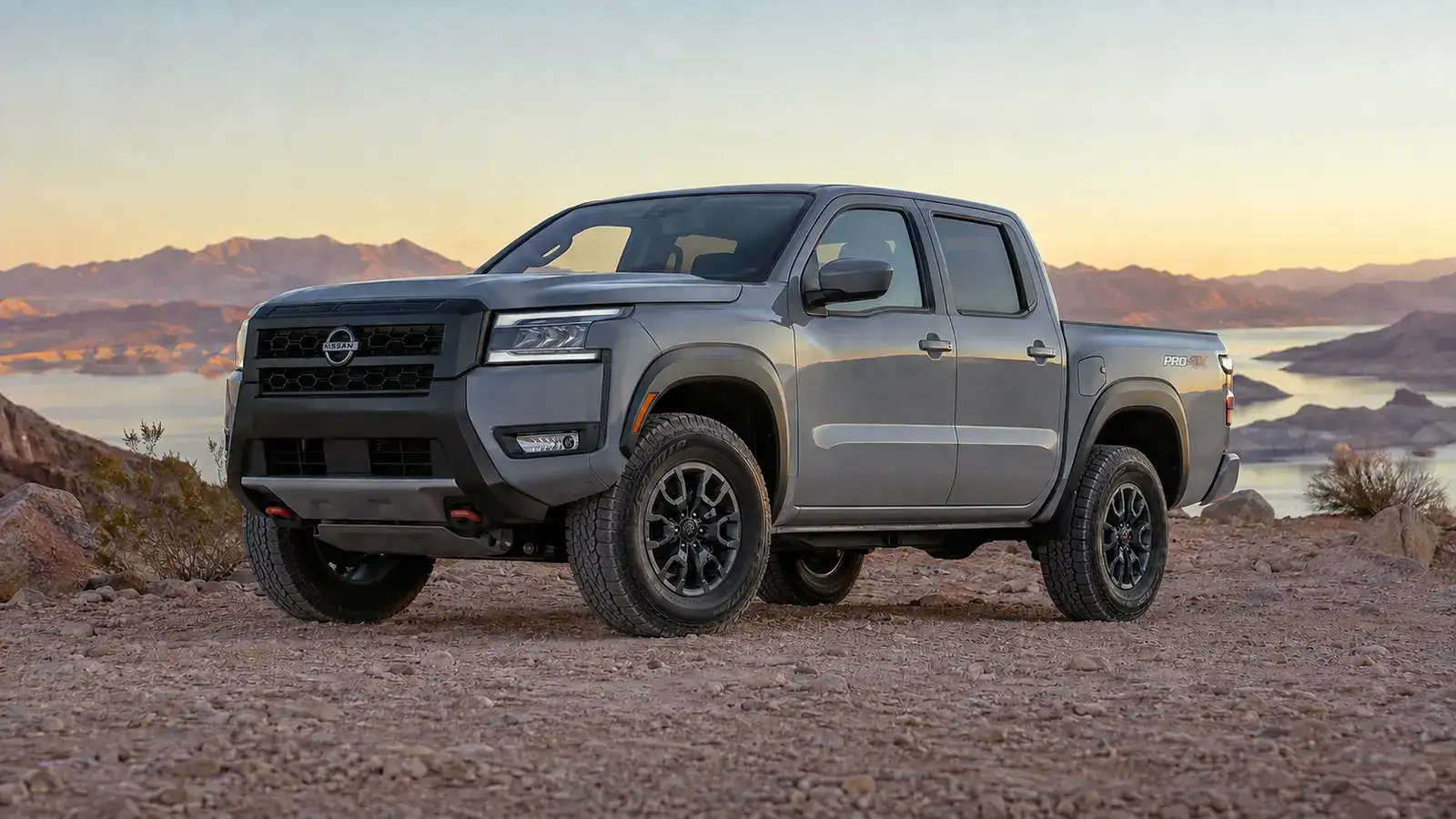
The Frontier is body-on-frame with a real transfer case and low range. It tows 43% more, goes places the Ridgeline physically cannot, and costs $8,445 less to drive off the lot.
Neither of those is “better.” They’re different trucks for different people. Here’s how to tell which one you are — plus one piece of news from Honda that belongs in your decision.
Properly equipped, SAE J2807 sea-level ratings
The Frontier tows 2,150 lbs more, or 43% more capacity. The Ridgeline is rated at 5,000 lbs on every trim.
Nissan Frontier vs. Honda Ridgeline: Full Spec Comparison
| Specification | 2026 Nissan Frontier | 2026 Honda Ridgeline |
|---|---|---|
| Starting MSRP | $32,150 | $40,795 (Sport) |
| Destination charge | $1,695 | $1,495 |
| Starting price with destination | $33,845 | $42,290 |
| Construction | Body-on-frame | Unibody (shared with Honda Pilot) |
| Trim levels | S, SV, PRO-X, PRO-4X | Sport, RTL, TrailSport, Black Edition |
| Trim pricing | $32,150 – $42,370 | $40,795 – $47,395 |
| Engine | 3.8L V6, naturally aspirated | 3.5L V6, naturally aspirated |
| Horsepower | 310 hp | 280 hp |
| Torque | 281 lb-ft | 262 lb-ft |
| Transmission | 9-speed automatic | 9-speed automatic |
| Drivetrain | 4×2 or 4×4 with 2-speed transfer case and low range | i-VTM4 AWD only — no low range, no 2WD option |
| Max towing | 7,150 lbs | 5,000 lbs (all trims) |
| Max payload | 1,590 lbs | 1,583 lbs (Sport); 1,509 lbs (Black Edition) |
| EPA combined MPG | 21 (4×2) · 19 (4×4) | 21 (Sport / RTL / Black Edition) · 20 (TrailSport) |
| Standard touchscreen | 8 inches | 9 inches |
| Maximum touchscreen | 12.3 inches | 9 inches — no larger option |
| Cab configurations | King Cab and Crew Cab | Crew cab only |
| Bed lengths | 5-foot and 6-foot | One 64-inch bed |
| Bed width between wheel wells | 44.5 in | 50.0 in |
| In-bed trunk | Not offered | Yes — lockable, 7.3 cu ft |
| Ground clearance | PRO-4X: 9.5 in | 7.64 in — every trim, TrailSport included |
| Off-road approach / departure | PRO-4X: 32.3° / 23.0° | TrailSport: 20.4° / 19.6° |
| Locking rear differential | Yes — PRO-4X | Not offered |
| Basic / powertrain warranty | 3 yr / 36k · 5 yr / 60k | 3 yr / 36k · 5 yr / 60k |
The TrailSport Detail Most Shoppers Miss
Honda markets the Ridgeline TrailSport as the rugged one — and it does add real equipment: General Grabber all-terrain tires, unique styling, orange interior stitching, and a retuned suspension.
What it does not add is ground clearance. Every 2026 Ridgeline, TrailSport included, sits at 7.64 inches unladen. That figure is identical across Sport, RTL, TrailSport, and Black Edition in Honda’s own specifications. The TrailSport is not lifted.
For comparison, the Frontier PRO-4X clears 9.5 inches, with a 32.3-degree approach angle against the TrailSport’s 20.4. That nearly 12-degree difference is what determines whether you clear a ledge or put your bumper into it.
Off-road trim of each, unladen
Every 2026 Ridgeline sits at 7.64 in, TrailSport included. The TrailSport is not lifted.
The TrailSport also carries the only fuel-economy penalty in the Ridgeline lineup — 18/23/20 versus 18/24/21 for every other trim — because of the all-terrain tires.
None of this makes the TrailSport a bad truck. It’s a very good one on graded dirt, washboard, and trailhead roads, which is where most people actually drive. But if you’re paying the TrailSport premium expecting more clearance than a base Ridgeline, you aren’t getting it, and you should know that before you sign.
Honda Has Confirmed a Production Pause
On July 23, 2026, Honda announced a third-generation Ridgeline arriving within two years. In the same release, the company stated: “Production of current 2026 Honda Ridgeline will pause later this year as Honda prepares for the new model.”
We’re including this because it’s material to your decision and it comes straight from Honda, not from speculation. It cuts both ways. If you want a Ridgeline, current-generation supply is finite and shopping sooner rather than later is reasonable. If you’d rather have the redesigned truck, waiting is also reasonable. Either way, you should hear it before you walk onto a lot, and you shouldn’t have to hear it from a salesperson who’d rather you didn’t ask.
Where the Nissan Frontier Wins
1. Towing — 7,150 vs. 5,000 pounds. That’s a 2,150-pound difference, or 43% more capacity. In practical terms: a loaded 24-foot travel trailer, a two-place enclosed snowmobile trailer, or a skid steer on a deck trailer are all inside the Frontier’s rating and outside the Ridgeline’s. If you tow anything substantial, this comparison ends here.
2. Real four-wheel drive. The Ridgeline’s i-VTM4 all-wheel-drive system is very good on wet pavement, gravel, and light dirt. But it has no low range, and no locking differential is available on any trim. The Frontier PRO-4X has a two-speed transfer case, an electronic locking rear differential, and skid plates. On the shelf roads out to Gold Butte or a rocky descent at Logandale, that’s not a preference — it’s a capability the Ridgeline doesn’t have.
3. Price, and it’s a wide gap. The Frontier starts at $33,845 delivered. The cheapest Ridgeline is $42,290 delivered. That’s $8,445. You can option a Frontier all the way to a loaded PRO-4X at $42,370 — matching the entry-level Ridgeline almost to the dollar — and get a truck that tows 1,310 pounds more with a locking rear diff and 9.5 inches of clearance.
MSRP plus destination charge
An $8,445 difference. A fully loaded Frontier PRO-4X at $42,370 costs about the same as the cheapest Ridgeline.
4. Bed length and cab choice. The Ridgeline comes exactly one way: crew cab, 64-inch bed. The Frontier offers a 6-foot bed and a King Cab configuration. For long cargo, the Frontier is the only one of the two with an answer.
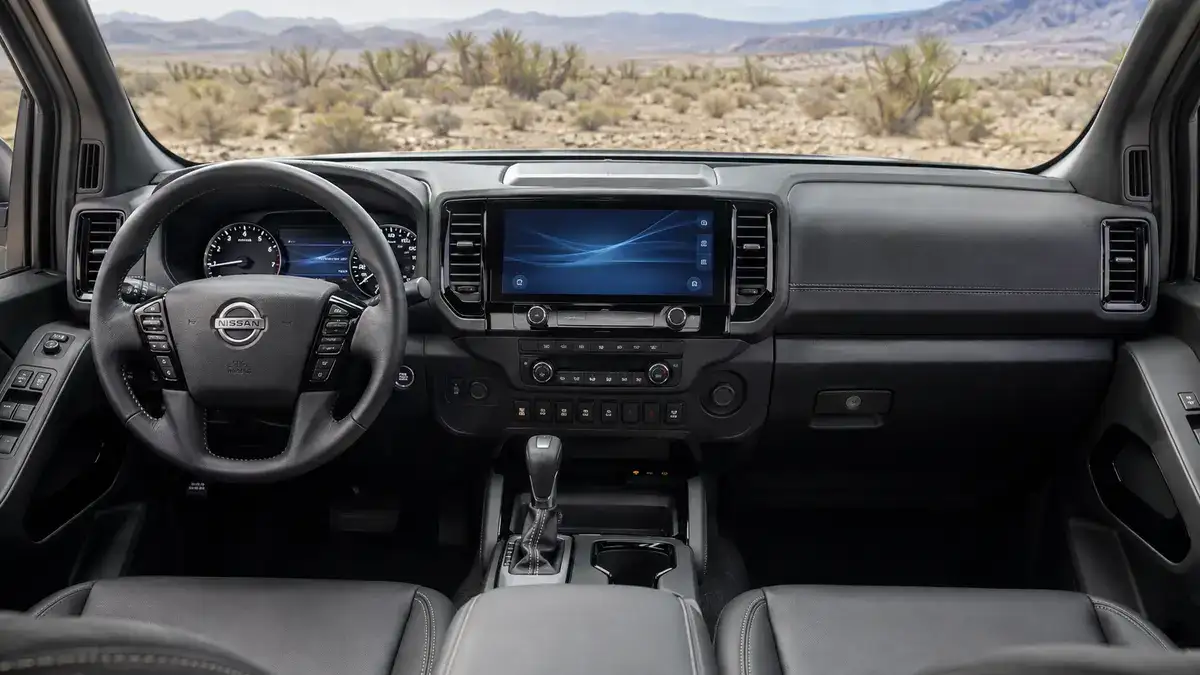
5. Screen size and power. The Frontier offers a 12.3-inch touchscreen; the Ridgeline maxes out at 9 inches with no larger option. The Frontier also makes 30 more horsepower and 19 more lb-ft of torque.
Where the Honda Ridgeline Wins
The bed is genuinely better designed. 50 inches between the wheel wells means a full 4×8 sheet of plywood or drywall lies flat on the bed floor. In the Frontier, at 44.5 inches, it rides on top of the wheel wells. If you regularly haul sheet goods, that’s a daily annoyance the Ridgeline solves and the Frontier doesn’t.
Whether a 4×8 sheet lies flat on the bed floor
The Ridgeline wins this one. A full sheet of plywood lies flat in a Ridgeline and rides on the wheel wells in a Frontier.
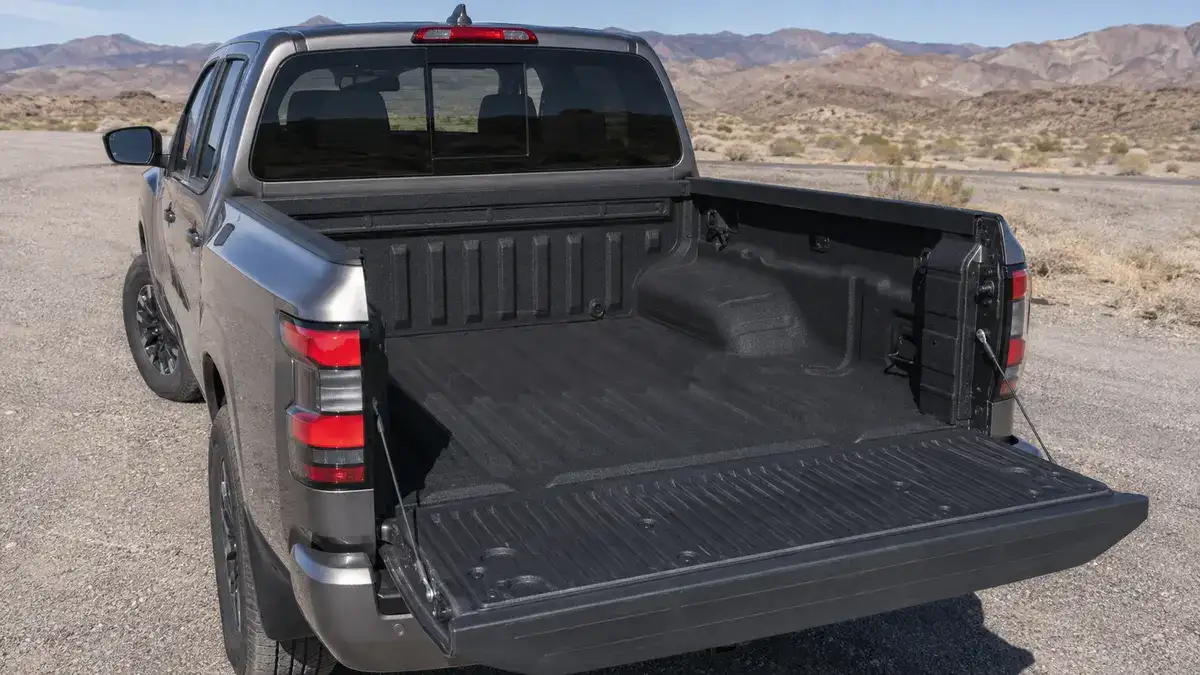
The in-bed trunk. 7.3 cubic feet of lockable, weatherproof storage under the bed floor, which also drains — people use it as a cooler at tailgates. Nothing in the midsize class matches it, and the Frontier has no equivalent.
The dual-action tailgate swings sideways as well as folding down, which makes loading heavy items much easier when you can’t drop the gate fully.
Ride quality. A unibody truck rides better than a body-on-frame truck, particularly unloaded. If most of your driving is the 215 and the 95 with an empty bed, the Ridgeline is the more comfortable vehicle and it isn’t close.
Lower destination charge. Honda charges $1,495 to the Frontier’s $1,695. It doesn’t come close to closing the overall gap, but it’s a point in the Ridgeline’s favor and we’re counting it.
Which One Should You Buy?
Buy the Honda Ridgeline if: you never tow more than 5,000 pounds; you haul sheet goods regularly and want them flat; the in-bed trunk and dual-action tailgate solve real problems for you; you want the most comfortable-riding truck in the class; and your off-roading is graded roads and trailheads rather than rocks.
Buy the Nissan Frontier if: you tow anything over 5,000 pounds; you want real 4×4 with low range and a locking differential; you need a 6-foot bed or a King Cab; you want to spend roughly $8,400 less to get started; or you want a truck that’s still a truck underneath.
See a Frontier in Las Vegas
If you’re cross-shopping these two, the honest advice is to be clear with yourself about what you actually tow and where you actually drive. If the answer is “a 6,000-pound trailer to Lake Mead,” the Ridgeline is off the list. If it’s “plywood to the jobsite and my kid’s soccer games,” it deserves a serious look — and we’ll tell you so.
Browse Frontier inventory · Current specials · Value your trade-in · Contact us to schedule a drive
Frontier vs. Ridgeline: Common Questions
How much more can the Nissan Frontier tow than the Honda Ridgeline?
The 2026 Nissan Frontier tows up to 7,150 pounds, while the 2026 Honda Ridgeline is rated at 5,000 pounds on every trim. That is a difference of 2,150 pounds, or approximately 43% more towing capacity for the Frontier.
Does the Honda Ridgeline TrailSport have more ground clearance?
No. Every 2026 Honda Ridgeline, including the TrailSport, has 7.64 inches of unladen ground clearance. Honda’s own specifications list the identical figure for the Sport, RTL, TrailSport, and Black Edition. The TrailSport adds all-terrain tires, a retuned suspension, and unique styling, but no lift. The Nissan Frontier PRO-4X has 9.5 inches of ground clearance.
Does the Honda Ridgeline have four-wheel drive?
No. The Honda Ridgeline uses Honda’s i-VTM4 all-wheel-drive system, which is standard on every trim. It does not offer a two-speed transfer case with low range, and no locking rear differential is available on any trim. The Nissan Frontier offers part-time four-wheel drive with a two-speed transfer case, and the PRO-4X trim adds an electronic locking rear differential.
Which is cheaper, the Nissan Frontier or the Honda Ridgeline?
The Nissan Frontier is substantially cheaper. The 2026 Frontier starts at $32,150 plus $1,695 destination, for $33,845 delivered. The 2026 Honda Ridgeline Sport starts at $40,795 plus $1,495 destination, for $42,290. That is a difference of $8,445, and the Frontier offers more towing capacity, more horsepower, and greater off-road capability.
Is Honda discontinuing the Ridgeline?
No. On July 23, 2026, Honda confirmed a third-generation Ridgeline arriving within two years and stated that production of the current 2026 Ridgeline will pause later this year as Honda prepares for the new model. The Ridgeline is being replaced, not discontinued.
Can you fit a 4×8 sheet of plywood in a Nissan Frontier?
A 4×8 sheet fits in the Frontier’s bed but rides on top of the wheel wells rather than flat on the bed floor, because the Frontier measures 44.5 inches between the wheel wells. The Honda Ridgeline, at 50 inches between the wells, allows a full sheet to lie flat. Buyers who regularly haul sheet goods should weigh this difference seriously.
Towing and payload figures are for properly equipped vehicles and vary with configuration, options, and passenger load. Manufacturer tow ratings are SAE J2807 sea-level figures — real capacity is reduced by altitude and high ambient temperatures, both of which apply in Southern Nevada. Always confirm against your vehicle’s door-jamb label. Honda specifications and pricing sourced from Honda as of August 2026 and subject to change; Honda charges an additional premium-color fee on some paints. Prices exclude tax, title, license, and dealer charges.
